
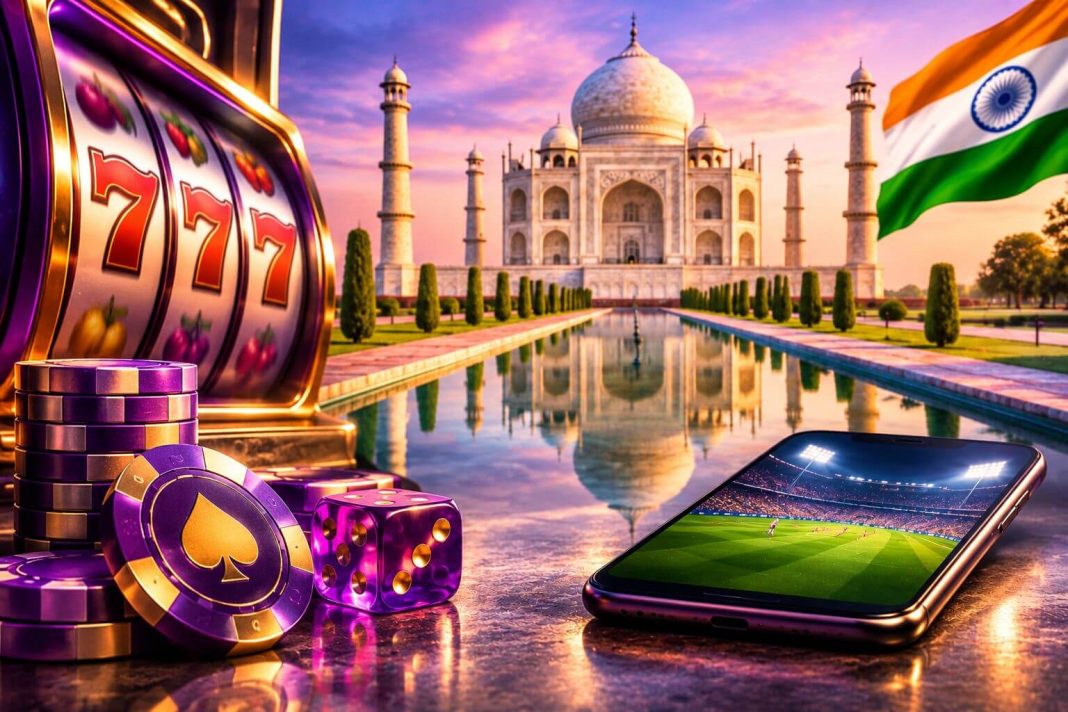

India remains one of the world’s largest potential audiences for online gambling, with a population exceeding 1.4 billion and approximately 650 million internet users. Yet the country’s gambling landscape is undergoing a fundamental transformation. New national legislation has prohibited online money games, while international gambling brands continue to generate measurable online interest.
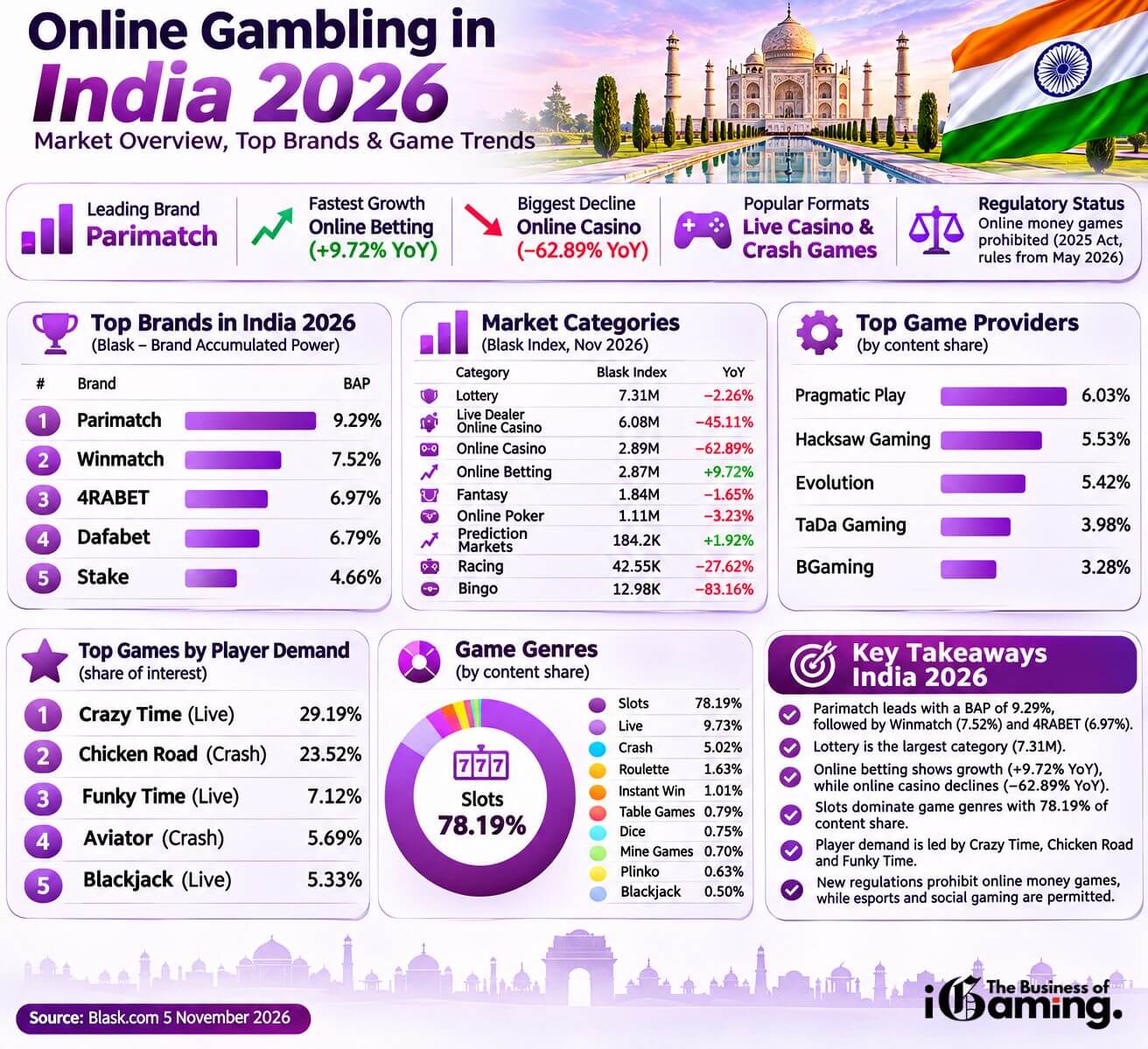
The latest Blask market intelligence data, dated November 2, 2026, tracks 544 gambling brands associated with the Indian market. Parimatch leads the rankings by Brand Acquisition Power (BAP), followed by Winmatch, 4RABET, Dafabet and Stake.
At the same time, the data reveals a striking change in player interest. Online casino demand has declined by 62.89% year-on-year, while live dealer casino interest has fallen by 45.11%. Online betting, however, has recorded an increase of 9.72%.
These figures raise an important question: how should the Indian online gambling market be understood in 2026, particularly after the introduction of a nationwide prohibition on real-money online games?
The answer requires looking beyond conventional market rankings. India’s gambling landscape now sits at the intersection of substantial digital demand, changing player preferences and one of the industry’s most consequential regulatory interventions.
India Gambling Market 2026 – Key Statistics
| Indicator | Latest figure |
| Population | 1.409 billion |
| Internet users | 650 million |
| Internet penetration | Approximately 46.1% |
| Median age | 29.8 years |
| Urban population | 36.4% |
| Gambling brands tracked | 544 |
| Game providers identified | 549 |
| Game genres | 17 |
| Games in player-demand ranking | 525 |
| Leading gambling brand | Parimatch |
| Leading gambling category | Lottery |
| Leading game provider | Pragmatic Play |
| Most represented game genre | Slots |
| Most popular game by SOI | Crazy Time |
| Online money gaming | Prohibited under national legislation |
Sources: Blask market intelligence, November 5, 2026; India demographic and economic statistics included in the market dataset; Government of India regulatory publications.
The distinction between measured gambling interest and legally permitted gambling activity is particularly important. Blask’s data provides insight into the visibility, demand and competitive positioning of gambling-related brands. It should not be interpreted as a measure of licensed gambling revenue or evidence that the listed operators are authorised to serve Indian customers.
Top 10 Online Gambling Brands in India in 2026
Parimatch occupies first place in India’s gambling brand rankings, with 9.29% Brand Acquisition Power and approximately 11.9 million Acquisition Power Score (APS).
Winmatch ranks second, followed by 4RABET and Dafabet.
The top ten also includes Stake, Tiranga, 91Club, 1Bet, Skyexch and FuninExchange.
Biggest Gambling Brands in India by Brand Acquisition Power
| Rank | Brand | APS | CEB (USD) | BAP | YoY |
| 1 | Parimatch | 11.9M | $431.16M | 9.29% | +28.45% |
| 2 | Winmatch | 9.72M | $351.95M | 7.52% | -18.37% |
| 3 | 4RABET | 9.11M | $390.16M | 6.97% | -31.05% |
| 4 | Dafabet | 8.83M | $431.23M | 6.79% | -20.19% |
| 5 | Stake | 6.12M | $301.69M | 4.66% | -60.15% |
| 6 | Tiranga | 1.72M | $47.79M | 4.28% | -34.17% |
| 7 | 91Club | 2.04M | $48.72M | 3.97% | -19.22% |
| 8 | 1Bet | 4.04M | $162.27M | 3.05% | -9.95% |
| 9 | Skyexch | 3.87M | $164.28M | 3.01% | +60.43% |
| 10 | FuninExchange | 1.03M | $28.91M | 2.68% | -30.9% |
Source: Blask, November 2, 2026. APS = Acquisition Power Score; CEB = Competitive Earning Baseline; BAP = Brand Acquisition Power. These are modelled market-intelligence indicators, not audited customers, deposits or operator revenue.
Parimatch Leads India’s Gambling Brand Rankings
Parimatch’s 9.29% BAP gives it a measurable advantage over Winmatch at 7.52% and 4RABET at 6.97%. Its year-on-year growth of 28.45% is also notable because most of the leading brands recorded declines.
Parimatch and Skyexch are the only two brands among the top ten showing positive annual changes in the latest dataset.
Skyexch stands out with 60.43% growth, although its overall BAP remains substantially smaller than Parimatch’s.
By contrast, Stake has experienced the steepest decline among the ten leading brands, falling 60.15% year-on-year.
This divergence suggests that changes in brand visibility and acquisition-related demand have not affected all operators equally.
What Does BAP Reveal About the Indian Market?
Brand Acquisition Power measures a brand’s relative position within Blask’s acquisition-intelligence framework. It provides a way to compare gambling brands without relying exclusively on website visits or reported revenues.
However, BAP should not be confused with traditional revenue market share.
Likewise, CEB represents a modelled competitive earning baseline rather than verified operator earnings.
This distinction is especially important in India, where measurable demand for gambling brands may persist even when real-money gambling services are prohibited.
Online Gambling Categories in India – Casino Interest Falls Sharply
One of the clearest findings in the latest data is the decline in online casino-related interest. Lottery remains the largest gambling category by Blask Index, followed by live dealer online casino, online casino and online betting.
India Gambling Categories Ranked by Blask Index
| Rank | Category | Blask Index | YoY |
| 1 | Lottery | 7.31M | -2.26% |
| 2 | Live Dealer Online Casino | 6.08M | -45.11% |
| 3 | Online Casino | 2.89M | -62.89% |
| 4 | Online Betting | 2.87M | +9.72% |
| 5 | Fantasy | 1.84M | -1.65% |
| 6 | Online Poker | 1.11M | -3.23% |
| 7 | Prediction Markets | 184.2K | +1.92% |
| 8 | Racing | 42.55K | -27.62% |
| 9 | Bingo | 12.98K | -83.16% |
Source: Blask, November 2, 2026.
Online Casino Interest Down 62.89%
The decline in online casino interest is one of the most significant developments in the Indian gambling dataset.
A year-on-year fall of 62.89% indicates that online casino-related demand has contracted substantially within Blask’s measurement framework.
Live dealer casino interest has also weakened, falling 45.11%.
Several factors could contribute to this pattern, including regulatory changes, restrictions on gambling advertising, changing search behaviour and shifts in operator visibility.
India’s national prohibition on online money games provides an important regulatory backdrop, although the dataset alone cannot establish how much of the decline was directly caused by legislation.
Online Betting Shows Greater Resilience
Online betting is the only major gambling category among the four largest to show positive annual growth. Its Blask Index increased by 9.72% to 2.87 million.
This creates a striking contrast with online casino and live dealer casino demand. It also suggests that different gambling verticals are experiencing substantially different patterns of online interest.
However, growth in betting-related interest should not be interpreted as evidence of legal market expansion or increased regulated gambling revenue.
Bingo Records the Largest Decline
Bingo has experienced the steepest contraction, falling 83.16% year-on-year. Its Blask Index stands at just 12,980, making it the smallest of the nine tracked gambling categories.
Racing has also declined significantly, while fantasy and online poker have recorded comparatively modest reductions.
Is Online Gambling Legal in India in 2026?
India’s online gambling framework changed substantially following the introduction of the Promotion and Regulation of Online Gaming Act, 2025.
The legislation establishes a national prohibition on online money games, including games involving monetary stakes and the expectation of financial returns.
Importantly, the prohibition covers games of chance, games of skill and games combining both elements.
The Promotion and Regulation of Online Gaming Rules, 2026 came into force on May 1, 2026, operationalising the national framework.
What Does India’s Online Gaming Law Prohibit?
The legislation prohibits the offering and facilitation of online money games, as well as their advertising and promotion. It also restricts financial transactions connected to prohibited online money gaming services.
The framework provides for enforcement measures, including blocking access to unlawful platforms.
At the same time, India distinguishes prohibited online money games from permitted categories of online social gaming and recognised esports.
This distinction is fundamental to understanding the country’s gaming industry.
India continues to support the development of digital games, esports and other forms of entertainment that fall outside the statutory definition of prohibited online money gaming.
The legislation is not simply a ban on all online games.
Regulatory sources: Government of India, Promotion and Regulation of Online Gaming Act, 2025; Promotion and Regulation of Online Gaming Rules, 2026.
What Does This Mean for International Gambling Operators?
India’s regulatory environment presents substantial legal barriers for gambling operators targeting domestic customers.
International operators cannot assume that holding a gambling licence in another jurisdiction authorises them to offer real-money gambling services in India.
The legislation also addresses online money gaming services operated from outside the country.
Consequently, gambling brands appearing in online market-intelligence rankings should not automatically be treated as legally available operators.
For companies analysing the Indian market, regulatory compliance must be considered separately from audience demand, brand recognition and online visibility.
Most Popular Casino Game Providers in India
Despite the decline in online casino interest, the Indian market continues to display measurable demand for casino gaming content.
Pragmatic Play leads the game-provider rankings with 6.43% content share, followed by Evolution and Hacksaw Gaming.
Top 10 Game Providers by Content Share
| Rank | Provider | Content share |
| 1 | Pragmatic Play | 6.43% |
| 2 | Evolution | 5.43% |
| 3 | Hacksaw Gaming | 5.03% |
| 4 | TaDa Gaming | 3.90% |
| 5 | BGaming | 3.86% |
| 6 | Pocket Games Soft | 2.61% |
| 7 | 3 Oaks Gaming | 2.23% |
| 8 | Playson | 2.19% |
| 9 | Amusnet | 2.05% |
| 10 | InOut Games | 1.89% |
Source: Blask, November 2, 2026. Content-share analysis covers 202 tracked brands.
Pragmatic Play Holds the Leading Position
Pragmatic Play’s 6.43% content share places it ahead of Evolution at 5.43% and Hacksaw Gaming at 5.03%. The relatively narrow gap between the leading providers indicates that casino content is distributed across several established suppliers.
Pragmatic Play also appears prominently in the player-demand rankings through games such as Gates of Olympus and Gates of Olympus Super Scatter.
Evolution’s position reflects the importance of live casino content, while Hacksaw Gaming is represented by crash-style titles and other casino products.
However, content share measures representation within the tracked catalogue, not the provider’s revenue or legally authorised distribution in India.
Slots Dominate Casino Game Content in India
Slots represent the overwhelming majority of casino game content in the Indian dataset. According to Blask, slots account for 78.49% of tracked casino content, followed by live casino games at 9.88% and crash games at 4.82%.
Casino Game Genres by Content Share
| Rank | Genre | Content share |
| 1 | Slots | 78.49% |
| 2 | Live | 9.88% |
| 3 | Crash | 4.82% |
| 4 | Roulette | 1.57% |
| 5 | Table Games | 0.81% |
| 6 | Dice | 0.81% |
| 7 | Instant Win | 0.80% |
| 8 | Mine Games | 0.79% |
| 9 | Plinko | 0.58% |
| 10 | Blackjack | 0.48% |
Source: Blask, November 2, 2026.
The dominance of slots is consistent with the broader international online casino industry, where slot games typically account for a large proportion of available titles.
However, content availability and player interest are not necessarily the same.
This becomes particularly clear when examining the most popular individual games in India.
Most Popular Online Casino Games in India
Live casino and crash games dominate the top positions in India’s player-demand rankings. Crazy Time leads with 29.19% Share of Interest (SOI), followed by Chicken Road with 23.52%.
Together, the two games account for 52.71% of measured interest among the ranked games.
Top 10 Casino Games in India by Share of Interest
| Rank | Game | Provider | Genre | SOI |
| 1 | Crazy Time | Various provider | Live | 29.19% |
| 2 | Chicken Road | InOut Games | Crash | 23.52% |
| 3 | Funky Time | Various provider | Live | 7.12% |
| 4 | Aviator | Spribe | Crash | 5.69% |
| 5 | Blackjack | Various provider | Live | 5.33% |
| 6 | Money Coming | TaDa Gaming | Slots | 5.17% |
| 7 | Dragon Tiger | Various provider | Live | 3.38% |
| 8 | Monopoly | Various provider | Live | 2.89% |
| 9 | Chicken Road 2.0 | InOut Games | Crash | 1.89% |
| 10 | Fortune Gems | TaDa Gaming | Slots | 1.49% |
Source: Blask, November 2, 2026.
Crazy Time Leads Player Interest
Crazy Time’s 29.19% Share of Interest makes it the most prominent individual game in the Indian dataset. The live casino game has a substantial lead over traditional blackjack and roulette products.
Its position illustrates the popularity of interactive live game-show formats, which combine familiar casino mechanics with entertainment-oriented presentation.
Funky Time and Monopoly also appear among the ten most popular games, reinforcing the visibility of live game-show content.
Chicken Road and Aviator Highlight Crash Game Demand
Crash games have become a significant part of the international online gambling landscape, and India’s player-interest rankings reflect this trend.
Chicken Road occupies second place with 23.52% SOI, while Aviator ranks fourth with 5.69%. Chicken Road 2.0 also appears in ninth position.
The combined presence of these games is particularly notable because crash titles account for only 4.82% of tracked game content.
This suggests that crash games generate disproportionately strong player interest relative to their share of the available catalogue.
Why Are Slots Less Prominent in Player-Demand Rankings?
Slots account for 78.49% of casino content but occupy only two places among the ten most popular games. Money Coming ranks sixth, while Fortune Gems occupies tenth place.
This reveals an important difference between content supply and concentrated interest in individual titles.
Slot content is distributed across a very large number of games, while demand for live game shows and crash games may be concentrated around a smaller selection of highly recognisable products.
For game developers and market analysts, this distinction is relevant when assessing content visibility and competitive positioning.
India’s Digital Population and Gambling Market Potential
India’s demographic profile helps explain why the country continues to attract considerable attention from international gaming companies.
With a population of approximately 1.409 billion and 650 million internet users, India has one of the largest digital audiences in the world.
Internet penetration stands at approximately 46.1% based on these figures, leaving a substantial proportion of the population outside the measured internet-user base.
The country’s median age of 29.8 years also points to a relatively young population.
India Demographic and Economic Overview
| Indicator | Figure |
| Population | 1,409,128,000 |
| Annual population growth | 0.72% |
| Internet users | 650 million |
| Internet penetration | Approximately 46.1% |
| Median age | 29.8 years |
| Male median age | 29.1 years |
| Female median age | 30.5 years |
| Urban population | 36.4% |
| Literacy rate | 74.4% |
| Real GDP, 2024 | $14.244 trillion |
| Real GDP growth, 2024 | 6.5% |
Source: India country statistics accompanying the market dataset. Economic and demographic figures reflect the reference periods shown, not necessarily current 2026 estimates.
A Large Audience Does Not Equal an Accessible Gambling Market
India’s population and internet-user figures indicate substantial digital scale. However, it would be misleading to convert this audience directly into a potential real-money gambling customer base.
Regulatory restrictions fundamentally change the commercial opportunity.
The more relevant opportunities for legally operating gaming companies may lie in social gaming, esports, game development, entertainment technology and other permitted digital gaming activities.
India’s large technology workforce and expanding digital infrastructure remain relevant to these sectors, regardless of restrictions on real-money gambling.
What the Data Reveals About India’s Online Gambling Market
The latest figures point to several important developments.
1. Gambling Brand Visibility Remains Significant
Blask tracks 544 gambling brands associated with India, indicating that a substantial number of operators continue to generate measurable online signals.
However, these figures do not establish that the brands are legally operating or accepting customers in the country.
2. Online Casino Interest Has Contracted Sharply
Online casino interest has declined 62.89%, while live dealer casino interest has fallen 45.11%.
These reductions are among the most important findings in the latest dataset.
They coincide with a period of significant regulatory change, although direct causation cannot be established from the figures alone.
3. Online Betting Interest Is More Resilient
Online betting has increased 9.72% year-on-year. This divergence suggests that different gambling categories are experiencing different demand patterns.
It does not, however, indicate that real-money betting has become legally permissible.
4. Live Casino and Crash Games Dominate Individual Game Interest
Crazy Time and Chicken Road account for more than half of measured interest among the ranked games.
Meanwhile, slots dominate content availability but have a smaller presence among the leading individual titles.
This difference highlights the importance of analysing both content supply and player-demand indicators.
5. Regulatory Compliance Is the Defining Market Constraint
India’s prohibition on online money games means that international gambling companies cannot evaluate the market solely through traffic, brand visibility or player interest.
Legal restrictions on gambling services, advertising and payment facilitation are central to any assessment of the market.
Outlook for Online Gambling in India Beyond 2026
India’s online gambling market presents a very different picture from jurisdictions moving towards regulated real-money gambling licensing. The country has introduced a national prohibition on online money games while supporting permitted esports and social gaming activities.
Against this backdrop, the continued presence of gambling-related online interest creates a complex market-intelligence picture.
International gambling brands remain visible in the data, and individual games such as Crazy Time and Chicken Road attract substantial measured interest.
Yet the commercial implications are constrained by national legislation.
For gambling operators, the central issue is no longer simply how large the Indian audience might become. It is whether any proposed activity falls within the legally permitted gaming framework.
For technology providers, game developers and digital entertainment companies, India remains an important market to study because of its population, internet-user base and technology sector.
Future developments will depend on regulatory enforcement, changes in online gaming behaviour and the evolution of permitted gaming categories.
Conclusion – India’s Gambling Market Is Being Reshaped
India remains a major source of online gambling-related interest, but its market structure has changed substantially. Parimatch leads the latest gambling brand rankings with 9.29% Brand Acquisition Power, while Winmatch and 4RABET occupy second and third positions.
At the category level, online casino interest has declined sharply, falling 62.89% year-on-year. Online betting has proved more resilient, recording growth of 9.72%.
Meanwhile, slots dominate casino content, but live casino and crash games generate much of the concentrated interest in individual titles. The most important development, however, is regulatory.
India’s nationwide prohibition on online money games has fundamentally altered the environment for gambling operators, advertisers and payment providers.
The result is a market where measurable digital interest remains substantial, but commercial activity is subject to significant legal restrictions.
For the international iGaming industry, India illustrates why audience demand, brand visibility and regulatory accessibility must be analysed as separate dimensions.
Methodology and Sources
This analysis uses Blask market intelligence data dated November 2, 2026, covering 544 tracked gambling brands in India.
The dataset includes Brand Acquisition Power (BAP), Acquisition Power Score (APS), Competitive Earning Baseline (CEB), Blask Index, provider content share and Share of Interest (SOI).
Provider and game-genre content shares cover 202 tracked brands. The player-demand dataset includes 525 games.
These metrics are modelled indicators of online market activity. They should not be interpreted as audited operator revenues, confirmed customer counts, licensed market shares or evidence of legally permitted gambling activity.
Regulatory information is based on India’s Promotion and Regulation of Online Gaming Act, 2025, and the Promotion and Regulation of Online Gaming Rules, 2026.
Sources: Blask.com, November 2, 2026; Government of India, Ministry of Electronics and Information Technology; Press Information Bureau.
Frequently Asked Questions
India’s Promotion and Regulation of Online Gaming Act, 2025 prohibits online money games, including games of chance and skill involving monetary stakes and potential financial returns. The implementing rules came into force on May 1, 2026.
Parimatch leads Blask’s November 2026 rankings with 9.29% Brand Acquisition Power, followed by Winmatch at 7.52% and 4RABET at 6.97%. These rankings measure market-intelligence indicators rather than licensed market share.
Blask tracks 544 gambling brands associated with the Indian market as of November 2, 2026.
Crazy Time leads the player-demand rankings with 29.19% Share of Interest, followed by Chicken Road at 23.52%.
Pragmatic Play leads with 6.43% content share, followed by Evolution at 5.43% and Hacksaw Gaming at 5.03%.
No. Blask’s latest figures show online casino interest declining by 62.89% year-on-year, while live dealer online casino interest has fallen by 45.11%.
Crash games feature prominently in the player-demand rankings. Chicken Road, Aviator and Chicken Road 2.0 all appear among the ten most popular individual games.
An overseas gambling licence does not automatically authorise an operator to provide real-money gambling services in India. The national legislation prohibits online money gaming services, including relevant services operated from foreign jurisdictions.